


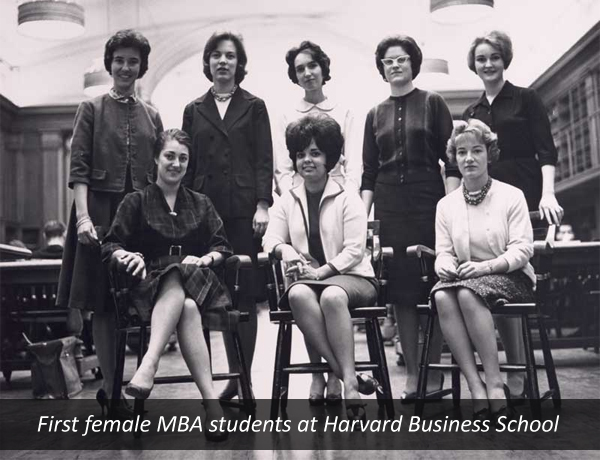
Although nowadays more and more female applicants enter top business schools, there are still nowhere near as many of them as there are men. This is why a female candidate application has to be more persuasive and confident.
Of course, many would argue that implying the need for a difference in male and female applications is sexist at the very least. Still, there is no way to ensure the absence of old-fashioned views in admissions boards.
The annually growing numbers of female applications notwithstanding, women are still considered to be a minority in business programs. GMAC surveys even suggest that the percentage of female candidates is decreasing – and this information is backed up by facts. For instance, in 2013 the number of female applicants for full-time MBA programs was 39%, and the next year it dropped by 2%.
This gap between men and women in business schools does not disappear after graduating: it is much more often that we see male entrepreneurs or CEOs than their female counterparts. This is why women who have to deal with situations like being the sole exception in an all-men company should try to get the most of the stereotypes working against them by radiating professionalism and self-confidence. Of course, it is impossible to make a list of rules suitable for every woman applicant – still, at least the tips represented in this article will highlight the most common problems of being a woman in the world of business.
Very often, members of admissions boards are unsure if a female candidate can keep up with men during rough business school discussions. Thus, former bosses or other recommenders of women applicants are constantly asked whether the recommendee can show confidence and provide arguments in such situations – which never happens when male candidates are applying to MBA programs.
Therefore, during interviews women applicants often have to show more confidence than they really have.
Also, many admissions officers state that women are more prone to shyness and insecurity when it concerns their achievements, background and skills. Stereotypically, girls are taught that pride and bragging are unacceptable in a woman, which then leads to their inability to form an adequate and positive self-image.
During the last ten years it has been one of the top priorities for business schools to improve this deplorable situation. Admittedly, there are now many more women in the business profession compared with twenty years ago. This concerns not only universities: many professions previously dominated by men now have a quota for female employees. Considering this, it is even easier to pursue a career in finance than to do so in more female-populated areas like management of brands or design.
Then again, there are some advantages for female candidates in the application process, namely their stereotypical ability to write more emotional essays and appear more devoted to their profession of choice during interviews. Thanks to this, female applicants sometimes have an easier time impressing admissions boards than their male counterparts.
For those women candidates who worry about sexism in business schools, there are at least two highly influential organizations helping women to enter MBA programs and pursue a career in business: Catalyst and Forte Foundation. Their goal is to organize events and sessions aimed at preparing women for the application process, as well as to explain them how to use their strengths and confidence during interviews. There also exist web sites and blogs sharing firsthand information from former female MBA students – these are very useful to help you avoid pitfalls when applying to a university.
To get the best out of studying at business schools, it’s better to carefully study program descriptions and thinks of ways to use and improve campus opportunities and activities.
The fact that women in business are now a minority may be used as a strong point without turning to a disadvantage. Some writers even suggest that it is much more advantageous to be a female business school student: it gives you more opportunity to show off your innovative and networking skills.
We do not need to tell you how important is an MBA degree for your career – just look through your goals and options, choose a target school and concentrate on getting the best education you can.


 Back to top